From the owner -
Bob Ballard,
RCDD, CFOI
We provide our students with a thorough understanding of fiber installation standards.  BDI DataLynk is a
Standards-Based Company offering BICSI Accredited, FOA Sanctioned, Fiber Optics Training Courses.  We
also teach long distance (Single Mode) fiber installation, testing and troubleshooting along with information
on how and when to use the OTDR and Power Source and Light Meter.  Our students are taught the 3-step
polishing process using 12, 3. and .3 micron polishing film.  This process yields the highest quality, lowest
loss, anaerobic or epoxy polish ceramic ferrule connector in the industry.  Our students have been able to
obtain between 0dB and .3 dB across two connectors single or multimode on a consistent basis using this
process.  This polishing process also helps to eliminate protrusion which is a major cause of connector
failure.  It further helps to eliminate undercut which results in high back reflection and high loss.  If a student
or a company specifically requests Corning Unicam or 3M Hotmelt training, we are happy to comply.  
However, we focus directly on the quality of the end face of the fiber optics connector irregardless of the
manufacture.  Per standards, each connector must meet certain requirements for retention, back reflection,
and attenuation.  We teach our students these standards.  As a result, our students are familiar with the
minimum industry requirements - no matter what connector system is used.

DO NOT BE FOOLED!  Many manufacturers offer "free fiber optics training certifications".  These
1- 2 day programs teach the technician how to install the manufacturer's products for warranty purposes. I
challenge anyone to ask specific questions to these "graduates" about fiber network installation, testing,
troubleshooting, and maintenance and I am confident they would not have learned what we teach in our
courses.

OUR PROGRAMS ARE LOW COST.  We are proud that we can bring a low cost, content
rich, product to an industry running amuck with high-priced installations and low quality workmanship.
Beware of so-called low price courses that teach you nothing and wastes YOUR valuable time.  Take a look
here for some examples.
Take a look at some of the neat tools we
share with our CFOT Students?
Are Your Fiber Optics Technicians Familiar With These Tools?
Do They Know How to Use Them Properly?
Is your technician using his pocket knife, or side cutters, hack
saw, an RPG, or High Explosives to "properly" remove the jacket
from cable - especially Black PE OSP Cable?
Ask one of our
students for a demo of this tool!
Bi-Directional Jack Slitter
Does your technician know how to use a VFL and Bare Fiber Adapter to
spot check the continuity of optical fiber before he/she spends all day
pulling in bad cable?
 Our students do!
VFL
Is your "experienced" technician knowledgeable about how to use a VFL to locate faults in an
accessable LAN fiber Optics network too close for an OTDR to see?  
Our students can!
Bare Fiber Adapter
Can your 30 year fiber optics technician use a Power Source and Light Meter along with Method B to identify which connector has the
highest loss.  Sometimes it is difficult to tell the difference between a .75dB and a 1.75dB connector.  This process would avoid cutting off
both connectors and re-terminating each one hoping to get the right one.
Our students can!
Power Source and Light Meter
OTDR
Is your basic technician or even your experienced one capable of
reading the OTDR trace to the right and identifying each event.  
Do they know what a Gainer is and it's causes.  Are they familiar
with the attenuation testing limitations and discrepancies of the
OTDR?  Can they identify "ghosts" and do they know the causes?
 Do they know about the LSA's and how to use them?  
Our
students can!
We challenge you to ask your Fiber Optics Technicians (30-year and 1 year) these
simple, basic questions below.  Our graduating techs can answer them
- can your technicians?
1.)  Per ANSI/EIA/TIA-568B.3, what is the maximum attenuation allowed per mated pair of
connectors?  What is the maximum attenuation allowed for a mechanical splice?
2.)  Which multimode fiber cable provides for 10GbE at 300 meters?
3.)  How does one perform a Link Loss Budget Analysis for a fiber optic system?  In other
words - how does one analyze the resulting attenuation of a fiber segment?  Is the Power too
high or is it too low and what does a good technician do about it in both respects?
4.) Using a Power Source & Light Meter, do you know how to determine which connector has
the higher attenuation when testing a fiber segment?
5)  Do you know how to use a Bare Fiber Adapter and a VFL?
6.)  Do you know how to read an OTDR Trace?  If so - what is a Gainer? What are LSA's?
7.)  What is the maximum pulling tension for installing indoor fiber optics cable?
8.)  Considering reference cables, can you explain Method B? Can you explain Method A?
9.)  What are the 4 elements that make up a fiber optic transmission system?
10.)  Erbium-doped optical fiber is used for what purpose?
"If your fiber installation technicians can not answer the basic
questions listed above, why not enroll them in our CFOT program
so they can do a better job for you AND for your customers."
--- Bob Ballard, RCDD, CFOI
About Our Technicians
Myths of Fiber
Cabling
Optical Fiber
Characteristics
Visit our new site
for Optical
Networking Tools
and Test
Equipment.
Go To:
Fiber Optics
Tools.Com
Find a Cabling
Contractor Today!
Statewide Telecom
Advanced Fiber Optic Training
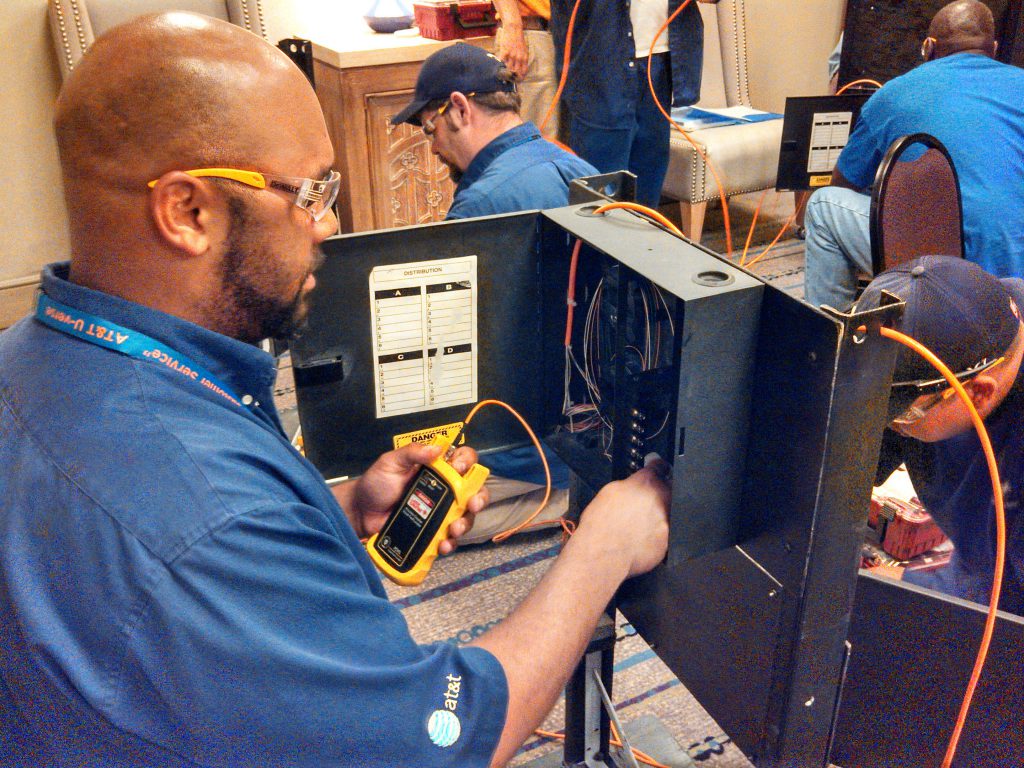
BDI DataLynk students build and test their own Fiber
Optics Networks.
We Teach Procedures...
Not Opinions!
BDI DataLynk, LLC
The Fiber Optic Training
Professionals
Courses Offered        2008 Schedule        About Us        About Our Techs.        Products        Services        Fiber Tech Database        Partnerships        Home          
Back To The Top --- About Us --- Our Services --- CFOT Course  --- Specialist in Testing & Maintenance --- Splicing Specialist --- 2008 Schedule
---
Industry News --- Course Benefits --- Contact us